

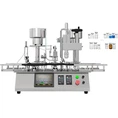
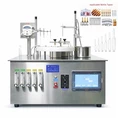

Capping machines are used to secure caps onto bottles and drums. There are three basic types of equipment: manual, semi-automatic, and automatic. Manual capping machines aid in the setting or holding of products. Operators are responsible for most controls and activities.
Benefits of Capping Machine
Sealing & Capping Finesse
The automatic capping machine is engineered to deliver impeccable sealing precision, ensuring that each product is securely sealed with an airtight finish. This meticulous sealing process guarantees the preservation of the pharmaceutical product's potency and efficacy, protecting it from external contaminants and environmental factors that could compromise its quality over time.
Turbocharged Efficiency
Operating at an impressive pace, the automatic capping machine significantly expedites the packaging process, enabling pharmaceutical companies to meet increasing production demands with exceptional speed and agility. By minimizing the time required for capping operations, this machine optimizes overall production efficiency, allowing companies to allocate resources effectively and maximize their output without sacrificing product quality or safety.
Tailor-Made Flexibility
Designed to accommodate various types of pharmaceutical containers, including bottles, vials, and jars of different shapes and sizes, the automatic capping machine offers unparalleled versatility. Its adaptable configuration allows for seamless transitions between different packaging formats, streamlining the production process and facilitating the efficient packaging of diverse pharmaceutical product lines. This flexibility empowers pharmaceutical companies to respond swiftly to market fluctuations and consumer preferences, ensuring that their packaging operations remain adaptable and responsive to evolving industry demands.
Advanced Safety Measures
Equipped with sophisticated torque control mechanisms and state-of-the-art sealing verification systems, the automatic capping machine prioritizes product safety and integrity. By meticulously controlling the sealing pressure, the machine minimizes the risk of product leakage and spillage, thereby safeguarding the pharmaceutical product from potential contamination or damage. Its advanced safety features not only ensure the longevity of the product but also reduce material wastage, leading to cost savings and promoting sustainable manufacturing practices within the pharmaceutical industry.


Why Choose Us
One-stop service
We promise to provide you with the fastest reply, the best price, the best quality, and the most complete after-sales service.
Customer Satisfaction
We are committed to delivering high quality services that exceed our clients' expectations. We strive to ensure that our clients are satisfied with our services and work closely with them to ensure their needs are met.
Competitive Pricing
We offer competitive pricing for our services without compromising on quality. Our prices are transparent, and we do not believe in hidden charges or fees.
Quality Assurance
We have a rigorous quality assurance process in place to ensure that all our services meet the highest standards of quality. Our team of quality analysts checks each project thoroughly before it is delivered to the client.
Expertise and Experience
Our team of experts have years of experience in delivering high quality services to our clients. We hire only the best professionals who have a proven track record of delivering exceptional results.
Customer Service
We earn your respect by delivering on time and on budget. We built our reputation on exceptional customer service. Discover the difference it makes.
You may have watched automatic capping machines in action before, but they often work so fast that you can't see exactly how they function.
In reality, the internal operations vary from one type to the next. For instance, a rotary capper will need to use a different application method than a straight line capper. However, the functionality of any bottle capping machine comes down to a two-phase process: Cap placement and cap sealing.
Fully-automatic machines will place caps onto containers using either a pick-off method or a pick and place method. The pick-off method uses a highly precise chute to dispense caps onto bottles, which are quickly passing under the chute to "pick off" the caps as they come down. This system is common, especially inline or straight line capping machines and with some rotary cappers running skirted and aluminum caps.
The pick and place method is more self-explanatory and involves a robotic or robotic-like arm presenting a cap for the cap chuck to grab and place onto the container while tightening. This method is more versatile, but requires greater levels of automation and tooling for a range of cap sizes and types.
Once the cap is placed on the container, the next step is to seal it. The mechanism used to seal the cap depends on the machine and bottle/cap design. For instance, skirted caps (like those used on beer bottles) are pushed down while threaded caps need to be rotated onto the bottleneck while the right amount of downward force is being applied.
Functionally, there's generally only one step that differentiates semi-automatic from fully-automatic, and that tends to be the need for a human to deliver the cap to the bottle. Still, the level of automation varies depending on the needs of the operation.
A semi-automatic chuck capper could be a tabletop version where a person is placing the bottle, then the cap, and letting the machine seal the cap down before repeating the process. Alternatively, a semi-automatic chuck capper could also be set up with a conveyor belt, which brings bottles under the machine automatically so that a human can place the cap before the machine seals it.
Semi-automatic capping machines are ideal for smaller operations and for specialized production runs. Meanwhile, fully-automatic capping machines are best suited for large operations, especially production runs that use the same actions all the way through. Ultimately, one is not necessarily better than semi-automation. The best solution depends on the needs of the operation.
What You Should Know About a Bottle Capping Machine
Before you buy a Bottle Capping Machine, you should know about its functions and features. Learn how it is classified and how much it will cost. Then, you can decide whether it is the right machine for you. Here are some important features and benefits to consider:
Features of Bottle Capping Machine
Bottle capping machines can be configured to automatically insert bottle caps into bottles. They store the caps in a tank or container and can quickly add them to bottles. To make use of these machines, you must first set the width and type of cap you want to insert. Some machines have special tools or jigs to help you with this process, while others simply require an operator. In any case, a bottle capping machine is a valuable investment for your company.
The Single-Head Automatic Bottle Capping Machine features a torque-controlled automatic system that is capable of handling both fragile and standard caps. The automatic bottle capping machine can regulate the torque of each head.
Bottle Capping Machine Functions
The maintenance of a bottle capping machine is a significant part of keeping the machine in good condition. Even if these machines are relatively easy to maintain, they must be kept in good condition to function efficiently. Without proper maintenance, a bottle capping machine will gradually lose its efficiency and start to break down, which can lead to a major loss of production. To keep your bottle capping machine in top shape, here are some of the basic steps you should take:
A capping machine is a vital component in bottling automation. It applies metal or plastic thread lids, caps, and plugs on bottles or containers. These machines ensure a sanitary work environment and high production rates. Furthermore, these machines also contribute to a more affordable manufacturing cost.
Classification of Bottle Capping Machine
The classification of bottle capping machines varies according to the type of containers they can handle. Fully automatic machines are designed to apply caps to a wide variety of containers, while semi-automatic machines require assistance from the operator. Some machines have the option of placing a cap manually on each container while others are fully automatic and require the operator's input. This difference in classification affects the price as well as the amount of repeat business.
Screw caps are the most common bottle caps. Screw caps are applied with a rotating screw structure, which generates high axial force when tightened. Screw caps are also easy to realize self-locking functions. Snap lids, on the other hand, are fixed to the container by a claw. Screw caps are common for beer bottles and can be applied by hand or automated machinery. Each of these types of closure requires a different type of machine and requires precise positioning.
Bottle Capping Machine Costs
Owning and maintaining bottle capping machines can be a full-time job. However, it's essential for your manufacturing business's profitability. Since most manufacturers rely on their on-site production line, it's critical to keep spare parts on hand. This will save you time and money when you face equipment malfunctions or looming breakdowns. Here are some costs of owning and operating a bottle capping machine.
Regular maintenance of bottle capping machines is an essential part of their functionality. Consistent maintenance ensures optimum performance and gives you peace of mind. A poorly maintained machine will eventually run at less than optimum capacity, and that can cost you a significant amount of revenue. To keep bottle capping machines in working order, make sure to regularly check their parts, especially the gearbox. Ensure that speed harmony is maintained between the various components.
In Conclusion
As the demand for packaged food has increased across various sectors, the market for bottle-filling machines has also increased. In addition to the food and beverage industries, capping machines are used in chemical, pharmaceutical, and cosmetics manufacturing industries. These machines help in enhancing the manufacturing process, and sanitization is likely to increase the demand for this equipment.
Applications of Capping Machine
Our capping machines, like other of packaging machinery, are used in a variety of industries. Several of these industries include the following:


General Packaging Applications
The capping machine is used in the general packaging of sensitive products. In a number of industrial situations, the capping machine can be employed. The equipment is often used to aid in the process of inserting and tightening packages' caps. The cosmetics industry, for example, uses a variety of containers to keep its product safe. The delicate nature of chemical goods necessitates the use of the equipment.
Food and Beverage Processing Applications
Drinks and food items are kept secure with the use of a capping machine. Almost all of the beverages you drink come in a can or a bottle. In addition, food processing firms use containers that are easy to shatter to preserve food. Capping machines aid in the capping of food containers in all of these procedures.
These drinks require safe handling and are sensitive to contaminants, thus they are capped tightly using a capping machine.
Agricultural Applications
The capping machine is used in the agricultural industry to prevent the harmful or poisonous effect of the substances from reach of children and other vulnerable groups. For example, while purchasing pesticides and solvent fertilizers, among other agricultural products, you can notice they are packaged in airtight containers. To ensure that the caps are impenetrable to tampering, capping machines are used by agricultural input providers.
Agricultural businesses of all sizes will buy liquid agrochemicals from producers to boost crop production. More organisms that destroy crops in the field may be controlled using herbicides and pesticides, insecticides and algaecides, and other substances. Soil conditioners and fertilizers, for example, are agrochemicals that aid plant development.
When these substances are physically handled or breathed, they may be exceedingly dangerous. When it comes to manufacturing and packing these chemicals in variable liquid quantities and inventory stock numbers, a capping machine is an essential answer.
Medical and Military Products
The capping machine is widely used in medical and military industries. Pharmaceutical companies often use a wide range of packaging materials when creating and delivering medication. This does not change in the slightest when it comes to military equipment. These industries need very tight seals because of their sensitivity. The tamper-proof seals are made by capping machines to prevent contamination.
Most of these products may be poisonous and sensitive to contamination. They are kept safe for use, by fixing caps tightly using capping machines.
Types of Capping Machines
Among capping machinery, there are a few different classes – the actual capping machines, cap sorters and cap elevators. Cap sorters work with the caps to orient them correctly before sending them along the line to the capping machines for placement. Cap elevators are part of a cap feeding system, and they are used to increase the efficiency of automatic capping machines as well as container unscrambling as the caps are pulled from a hopper and then transported to the next stop in the line. As for the actual capping machines, those include:
Chuck cappers: Chuck cappers work by placing a cap onto a container, then sending it through the machine, where the moving parts spin the cap so it is sealed tightly. With this machine, the container is in continuous motion, rather than stopping at a spin station, as happens with spindle cappers.
Spindle cappers: A similar machine to chuck cappers, instead these stop the containers at stations and spin the caps onto the container while the containers remain stationary.
Snap cappers: Snap cappers work by pressing a snap-on cap to each container as it traverses through the machine
Vertical wheel pluggers: Finally, wheel pluggers are used where the containers being sealed require a plug instead of a cap placed on top
A capping machine is a crucial component of any automated bottling line. This machine can cap bottles, jars and other types of resealable packaging quickly and accurately.
Features of automatic capping machines
Nowadays, capping machines can be found on any production line that fills products into containers. They are high-speed machines that operate at high capacity, so while their role and general principle of operation are rather obvious, the exact capping process may not be so clear. This is why we will start with a brief overview of what the process looks like and what is included in the capping equipment.
Capping takes place as soon as the container is filled. Open containers enter the machine and leave it tightly closed. In some instances, the capping machine also seals the packaging so that the final consumer may be certain that no one has tampered with the contents of the container after it has left the production line. For instance, the pharmaceutical business frequently uses this procedure.
In order for the packaging to be closed with a screw cap, it must first be delivered to the container. The cap delivery system is responsible for this. Machine manufacturers employ two distinct systems to complete this task, depending on the kind of the capping machine, the type of packaging and the cap.
The pick-off system is the first of these systems. It uses a precise chute to dispense the caps one by one, which are then "picked up" by containers that are carried on a conveyor under the chute to deliver them to the tightening section. It is mainly utilised in rotary and linear capping machines.
A pick-and-place system, which is the second option, operates on the principle that a robotic arm or manipulator can move along two or three axes. The robot or manipulator has a gripper, which picks up the caps from a tray and places them on the containers. This system is versatile enough to be used for a wide variety of caps and packaging.
Once the cap is on the container, the machine moves on to the most important part of the process: capping. The capping equipment seals the connection between the container and the cap. The type of mechanism used for this depends on the type of machine, since different capping machines employ various tightening systems. When it comes to bottle capping with screw caps, for instance, the capping machine needs to rotate the cap while applying pressure to it in order to seal the packaging.
Different types of capping machines
The capping machine with a tightening head is the most common type of these machines. The capping equipment uses the torque transferred by the head to lower and tighten the cap as soon as the packaging is in place.
Both large plants and small batch production can both use this kind of capping machines. There are three types of capping machines with tightening heads: automatic, semi-automatic and manual capping machines. When using a semi-automatic device, the operator places the cap on the container, which is then tightened by the machine. In most cases, these are the continuous motion machines, which means that the product does not stop when the cap is being tightened and the head screws the cap as the container advances along the conveyor.
Spindle capping machines are another widely used type of capping devices. They use special sets of spinning discs, some of which are powered, to tighten the caps. Once the packaging is in the proper position, the discs are pressed up against the cap, thereby sealing the container. This kind of machinery is intermittent motion equipment, which means that the containers are temporarily stopped on the line during tightening.
Capping machines – examples of applications
The packaging industry makes extensive use of capping machines, which frequently assist the packaging process by fitting and tightening caps. The cosmetics industry is a prime example of this, as it uses a variety of screw-on containers to further secure beauty products.
The food sector as a whole, particularly the brewing industry and bottling plants, which specialise in bottle capping, are the primary customers for producers of capping machines. Food producers, on the other hand, use screw-on jars and containers to hold spices, preserves and a variety of other products. Because of this, the capping machine is very common in the production line of food processing plants.
The agricultural sector also uses capping machines, which make sure that all kinds of dangerous substances are placed in a sealed container in such a way that they cannot leak or be easily accessed by a child. Additionally, capping machines relieve people from working in harmful conditions so that operators do not come into contact with substances that are potentially dangerous for their health.
Another industry where the capping machine is used is, of course, the pharmaceutical sector. Pharmaceutical companies use a wide range of screw-on jars and containers to protect medical supplies until they are delivered to patients. Being able to precisely control the capping process, drug manufacturers can be certain that the products leaving their production lines are properly sealed and protected.
Our Factory
We have rich experience in equipment automation. In addition to the design and manufacture of conventional equipment, we can also customize product design solution according to user needs. The company has its own lathes and milling machines, and two senior fitters, who can make samples and processing parts at any time. While product quality is guaranteed, it can respond quickly to user needs. We have an excellent sales team who have a good understanding of the product performance, can understand customer needs in a timely manner, and can fully display the advantages of the product. We have 3 after-sales person. Whenever we receive user appeals, we will respond immediately within 24 hours, Come up with a solution. with a aim to create more value to our visionary customers and grow big together.

FAQ
Q: What is a caps machine?
Q: What is filling and capping machine?
Q: What are the advantages of capping machine?
Q: How does a capper work?
Q: What is the function of bottle capping machine?
Q: What is the capping process for bottles?
Q: What is crown capping machine?
Q: What is a bottle cap simple machine?
Q: What is bottle filling and capping machine?
Q: How does the filling machine work?
Q: How do you clean a vial filling machine?
Q: What is the most common vial size?
Q: How do I choose a filling machine?
Q: What are the applications of capping machine?
Q: What is meant by capping machine?
Q: What is the importance of filling machine?
Q: What is the vial filling process?
Q: How many types of filling machines are there?
Q: What is the capacity of vial filling machine?
Q: What is the principle of vial filling and sealing machine?
Hot Tags: capping machine, China capping machine manufacturers, suppliers, factory, automatic vial filling and stoppering machine, automatic vial filling machine, vial filling and stoppering machine, vial filling and capping machine, vial capping machine, vial filler


