


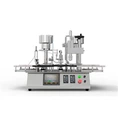
Hey there! As a vial filler supplier, I'm super excited to dive into the mechanical structure features of a vial filler with you. These machines are pretty amazing pieces of equipment, and understanding their ins and outs can really help you make the right choice when it comes to procurement.
Let's start with the frame. The frame of a vial filler is like the backbone of the whole machine. It's usually made of high - quality stainless steel. Why stainless steel? Well, it's durable, resistant to corrosion, and easy to clean. In the pharmaceutical and food industries, where hygiene is of utmost importance, a stainless - steel frame ensures that the machine can withstand regular cleaning with harsh chemicals without getting damaged. This also helps in maintaining a sterile environment, which is crucial for filling vials with products that need to be free from contaminants.
Next up, the conveyor system. This is what moves the vials through the filling process. A good vial filler has a smooth - running conveyor. It's designed to handle different sizes and shapes of vials. The conveyor speed can often be adjusted according to the production requirements. For example, if you're filling small vials with a high - volume production target, you can increase the conveyor speed. But if you're dealing with larger, more delicate vials, you might want to slow it down to ensure accurate filling. Some conveyors even have sensors that can detect if a vial is missing or misaligned. If a problem is detected, the machine can stop automatically to prevent any filling errors.
Now, let's talk about the filling system. There are different types of filling systems in vial fillers, such as piston fillers, peristaltic fillers, and gravity fillers. Piston fillers are great for filling viscous liquids. They work by using a piston to draw the liquid into a chamber and then push it out into the vial. The volume of the liquid filled can be precisely controlled by adjusting the stroke of the piston. Peristaltic fillers, on the other hand, are ideal for filling sensitive or shear - sensitive liquids. They use a rotating roller to compress a flexible tube, which squeezes the liquid out into the vial. This method doesn't contaminate the liquid with moving parts inside the fluid path, which is a big plus for certain applications. Gravity fillers are simple and cost - effective. They rely on gravity to fill the vials, which is suitable for low - viscosity liquids.
The nozzles are another important part of the filling system. The design of the nozzles can greatly affect the filling accuracy and the quality of the fill. Some nozzles are designed to prevent dripping. They have features like anti - drip valves that close immediately after filling to stop any excess liquid from falling into the vial or onto the machine. There are also nozzles with different shapes and sizes to accommodate different vial openings and filling requirements. For example, a long, thin nozzle might be used for filling vials with narrow necks, while a wider nozzle could be used for larger vial openings.
The stopper insertion mechanism is also a key feature. After the vials are filled, they need to be stoppered. A good vial filler has a reliable stopper insertion system. It can pick up the stoppers from a hopper and place them accurately on top of the vials. The insertion force can be adjusted to ensure that the stoppers are inserted tightly enough to seal the vials but not so hard that they damage the vials. Some machines can also detect if a stopper is missing or not inserted correctly and take appropriate action, like rejecting the faulty vial.
Now, about the capping part. If you're interested in a complete vial filling and sealing solution, you might want to look into a machine that includes a capping function. A Capping Machine can apply different types of caps, such as screw caps, snap - on caps, or crimp caps. The capping mechanism is designed to apply the right amount of torque to ensure a tight seal. It can handle caps of different sizes and materials, and it can be adjusted easily to fit your specific capping requirements.
If you're in the market for a more integrated solution, you might consider an Automatic Vial Filling Stoppering and Capping Machine. This type of machine combines the functions of filling, stoppering, and capping in one unit. It can streamline your production process and increase efficiency. It's also more space - saving compared to having separate machines for each step.
A Vial Filling Machine on its own is great for just the filling part. It can be customized to meet different production needs. You can choose the number of filling heads according to your production volume. For high - volume production, you might want a machine with multiple filling heads so that you can fill several vials at the same time.
And of course, we have the Vial Filler which is the core of the whole operation. It's designed to work smoothly and accurately, ensuring that each vial is filled with the right amount of product.
Another aspect to consider is the control system. Modern vial fillers are equipped with advanced control systems. You can use a touch - screen interface to set up different parameters such as filling volume, conveyor speed, and capping torque. The control system also allows you to monitor the production process in real - time. You can see how many vials have been filled, if there are any errors, and adjust the settings on the fly if needed.
Maintenance is also a big deal. A well - designed vial filler should be easy to maintain. The parts should be accessible for cleaning and replacement. Some machines even come with self - diagnostic features. They can detect if a component is about to fail and alert you so that you can replace it before it causes any production downtime.


If you're looking for a vial sealing solution, you can check out our Vial Sealing Machine. It's designed to provide a tight and reliable seal for your vials, ensuring the integrity of the product inside.
In conclusion, the mechanical structure features of a vial filler play a crucial role in its performance, efficiency, and reliability. Whether you're in the pharmaceutical, food, or cosmetic industry, choosing the right vial filler can make a big difference in your production process. If you're interested in learning more about our vial fillers or have specific requirements for your production line, don't hesitate to reach out. We're here to help you find the perfect solution for your business.
References
- General knowledge of vial filling and capping machine technology
- Industry standards and best practices for vial filling equipment