


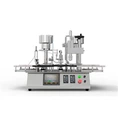
As a trusted labeling machine supplier, I'm often asked about how our machines handle label registration. Label registration is a crucial aspect of the labeling process, ensuring that labels are accurately placed on products. In this blog post, I'll delve into the intricacies of how our labeling machines achieve precise label registration.
Understanding Label Registration
Label registration refers to the process of aligning the label with the product at the correct position and orientation. This is essential for products where the label's placement is critical for branding, product information, or regulatory compliance. For example, on a pharmaceutical product, the label must be precisely placed to ensure that dosage instructions and warnings are clearly visible.
Technologies Used in Label Registration
Our Labeling Machine Labeling Machine employs a variety of technologies to achieve accurate label registration.
Optical Sensors
Optical sensors are commonly used in our labeling machines. These sensors detect specific marks on the label, such as registration marks or color contrasts. The machine uses the information from the sensors to adjust the label's position in real - time. For instance, if the sensor detects that the label is slightly off - center, the machine can correct the placement by adjusting the label feed speed or the position of the labeling head.
Encoders
Encoders are another important component in achieving label registration. They are used to measure the movement of the label material and the product. By precisely tracking the distance traveled by the label and the product, the machine can synchronize the labeling process. For example, an encoder on the label roll can measure the length of the label material that has been fed, and an encoder on the product conveyor can measure the position of the product. This information is used to ensure that the label is applied at the right moment.
Servo Motors
Servo motors play a vital role in our labeling machines. They are used to control the movement of the labeling head and the label feed system. Servo motors offer high - precision control, allowing for accurate positioning of the label. For example, when applying a label to a curved surface, the servo motor can adjust the angle and position of the labeling head to ensure a perfect fit.
The Label Registration Process
The label registration process in our machines can be broken down into several steps:
Initial Setup
Before starting the labeling process, the operator must set up the machine for the specific product and label. This includes adjusting the sensors to detect the registration marks on the label, setting the correct label feed speed, and calibrating the encoders. The operator also needs to input the dimensions of the product and the label to ensure accurate placement.
Label Detection
Once the machine is set up, the label detection phase begins. The optical sensors scan the label material as it is fed through the machine. When a registration mark is detected, the sensor sends a signal to the machine's control system.
Product Detection
At the same time, the machine also detects the presence and position of the product. This can be done using sensors on the product conveyor. Once the product reaches the labeling position, the control system prepares to apply the label.


Synchronization
The machine then synchronizes the label and the product. Using the information from the encoders and sensors, the control system ensures that the label is fed at the right speed and the labeling head is positioned correctly. The servo motors adjust the movement of the labeling head and the label feed system to match the product's speed and position.
Label Application
Finally, the label is applied to the product. The labeling head presses the label onto the product surface with the right amount of pressure to ensure a firm attachment.
Challenges in Label Registration
Despite the advanced technologies used in our labeling machines, there are still some challenges in label registration.
Label Material Variations
Different label materials have different properties, such as stretch, thickness, and surface finish. These variations can affect the accuracy of label registration. For example, a label material that stretches easily may cause the registration marks to shift during the labeling process. To overcome this challenge, our machines are designed to be adjustable. The operator can fine - tune the settings of the sensors, encoders, and servo motors to compensate for the label material's properties.
Product Shape and Size Variations
Products come in various shapes and sizes, which can pose a challenge for label registration. For example, applying a label to a cylindrical product requires a different approach than applying a label to a flat - surfaced product. Our labeling machines are equipped with flexible labeling heads and adjustable conveyor systems that can be customized to handle different product shapes and sizes.
High - Speed Production
In high - speed production environments, maintaining accurate label registration becomes more difficult. The machine needs to process a large number of products in a short period, which requires fast and precise control. Our machines are designed with high - performance control systems and powerful servo motors to ensure accurate label registration even at high speeds.
Case Studies
Let's take a look at some real - world examples of how our labeling machines handle label registration.
Pharmaceutical Industry
In the pharmaceutical industry, label registration is of utmost importance. One of our clients, a pharmaceutical company, needed to label small vials with precise dosage information. Our labeling machine was equipped with high - resolution optical sensors to detect the small registration marks on the labels. The servo motors were programmed to adjust the labeling head's position to ensure that the labels were accurately placed on the curved surface of the vials. This helped the client meet the strict regulatory requirements and maintain the integrity of their product branding.
Food and Beverage Industry
Another client in the food and beverage industry needed to label different - sized bottles at high speeds. Our machine used a combination of encoders and optical sensors to synchronize the label application with the movement of the bottles. The adjustable conveyor system and labeling head allowed for easy adjustment to accommodate different bottle sizes. As a result, the client was able to increase their production efficiency while maintaining accurate label registration.
Conclusion
In conclusion, label registration is a complex but essential process in the labeling industry. Our labeling machines Labeling Machine use advanced technologies such as optical sensors, encoders, and servo motors to achieve accurate label registration. Despite the challenges posed by label material variations, product shape and size variations, and high - speed production, our machines are designed to provide reliable and precise label placement.
If you're in the market for a Labeling Machine or a Blister Packing Machine Blister Packing Machine, we'd love to have a discussion with you about your specific requirements. Our team of experts can help you choose the right machine and customize it to meet your production needs. Don't hesitate to reach out to us for a detailed consultation and to explore how our solutions can enhance your labeling process.
References
- Endress, H., & Reinhold, H. (Eds.). (2017). Handbook of Packaging Development. Wiley-VCH.
- Clegg, D. (2019). Labeling and Coding of Consumer Products. Elsevier.