


In the pharmaceutical and biotechnology industries, the choice between a rotary and linear vial filler for high - speed production is a critical decision that can significantly impact efficiency, productivity, and overall manufacturing costs. As a vial filler supplier, I have witnessed firsthand the advantages and limitations of both types of filling machines in various production environments. In this blog, I will delve into the characteristics of rotary and linear vial fillers, compare their suitability for high - speed production, and provide insights to help you make an informed decision for your manufacturing needs.
Understanding Rotary Vial Fillers
Rotary vial fillers are designed with a circular carousel that rotates continuously during the filling process. This design allows for multiple filling stations to operate simultaneously, enabling high - speed production. As the vials are placed on the carousel, they move through a series of stations where filling, stoppering, and capping operations can be performed in a sequential manner.
One of the key advantages of rotary vial fillers is their high throughput. The continuous rotation of the carousel enables a large number of vials to be filled in a short period. For example, in a well - designed rotary filler, it is possible to fill hundreds of vials per minute, making them an ideal choice for large - scale production facilities.
Another benefit of rotary vial fillers is their precision. The design of the carousel ensures that each vial follows a consistent path through the filling stations, reducing the variability in filling volumes. This precision is crucial in industries such as pharmaceuticals, where accurate dosing is essential for product safety and efficacy.
However, rotary vial fillers also have some limitations. They tend to be more complex and expensive to purchase and maintain compared to linear vial fillers. The circular design requires a larger footprint in the production facility, which can be a constraint in smaller manufacturing spaces. Additionally, the setup and changeover times for rotary vial fillers can be longer, as the carousel needs to be adjusted and calibrated for different vial sizes and filling requirements.
Exploring Linear Vial Fillers
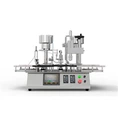
Linear vial fillers, on the other hand, operate on a linear conveyor system. Vials are transported in a straight line through a series of filling stations, where the filling, stoppering, and capping operations are carried out.
One of the main advantages of linear vial fillers is their flexibility. They can be easily configured to accommodate different vial sizes and shapes, as the linear conveyor system allows for more straightforward adjustments. This makes them a popular choice for contract manufacturing organizations (CMOs) and facilities that produce a wide range of products.
Linear vial fillers are also relatively easy to install and maintain. Their simpler design means that there are fewer moving parts, reducing the risk of mechanical failures and downtime. The smaller footprint of linear vial fillers makes them suitable for smaller production facilities or those with limited floor space.
However, linear vial fillers generally have a lower throughput compared to rotary vial fillers. The linear conveyor system limits the number of filling stations that can operate simultaneously, resulting in a slower filling rate. In high - speed production scenarios, this can be a significant drawback, as it may require multiple linear fillers to achieve the same output as a single rotary filler.
Comparing Rotary and Linear Vial Fillers for High - Speed Production
When it comes to high - speed production, several factors need to be considered when choosing between a rotary and linear vial filler.
Throughput
As mentioned earlier, rotary vial fillers have a clear advantage in terms of throughput. Their ability to operate multiple filling stations simultaneously allows for a much higher filling rate compared to linear vial fillers. In large - scale production facilities where high volumes need to be filled quickly, a rotary vial filler is often the preferred choice.
Precision
Both rotary and linear vial fillers can achieve high levels of precision in filling. However, the continuous rotation of the carousel in a rotary vial filler may provide a more consistent filling environment, resulting in slightly better precision in some cases. This is especially important in industries where accurate dosing is critical.
Flexibility
Linear vial fillers offer greater flexibility in terms of vial size and shape compatibility. If your production facility needs to handle a variety of products with different vial specifications, a linear vial filler may be more suitable. Rotary vial fillers, while they can be adjusted for different vial sizes, may require more extensive retooling and calibration.
Cost
The cost of purchasing and operating a vial filler is an important consideration. Rotary vial fillers are generally more expensive to purchase and maintain due to their complex design and higher number of moving parts. Linear vial fillers, on the other hand, are more cost - effective in terms of initial investment and ongoing maintenance. However, in high - speed production scenarios, the increased throughput of a rotary vial filler may offset the higher cost over time.
Space Requirements
Rotary vial fillers require a larger footprint in the production facility due to their circular design. If space is limited, a linear vial filler may be a better option, as they have a smaller and more compact design.
Integration with Other Equipment
In a production line, vial fillers need to be integrated with other equipment such as Stoppering Machine and Capping Machine. Rotary vial fillers are often designed to be integrated seamlessly with other rotary - based equipment, which can improve the overall efficiency of the production line. Linear vial fillers, on the other hand, can be more easily integrated with linear - based equipment, providing greater flexibility in the layout of the production line.
Making the Right Choice
The choice between a rotary and linear vial filler for high - speed production depends on your specific production requirements. If you have a large - scale production facility with a high demand for throughput and precision, and space is not a major constraint, a rotary vial filler may be the best choice. On the other hand, if you need flexibility in vial size and shape compatibility, have a limited budget, or a smaller production space, a linear vial filler may be more suitable.


As a vial filler supplier, we understand that every production facility is unique, and we are committed to helping you find the right solution for your needs. Our team of experts can provide in - depth consultations, conduct on - site evaluations, and offer customized solutions to ensure that your production line operates at maximum efficiency.
If you are considering upgrading or purchasing a new Vial Filling Machine, we invite you to contact us to discuss your requirements. Our experienced sales team will be happy to answer your questions and provide you with detailed information about our products and services. Let us work together to optimize your high - speed production process and achieve your manufacturing goals.
References
- Pharmaceutical Filling Technology Handbook, Second Edition. Edited by James W. McGinity and Michael C. Martin.
- Handbook of Pharmaceutical Manufacturing Formulations: Sterile Products. Edited by Sarfaraz N. Khadra.
- Pharmaceutical Process Scale - up. By Eric L. K. Sung.