


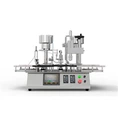
What's up, folks! I'm a supplier of filling machines, and today I wanna chat about the filling capacity of small - scale filling machines. You might be wondering, "Why's the filling capacity such a big deal?" Well, it's kind of the bread and butter when it comes to choosing the right filling machine for your business.
Let's start by getting clear on what we mean by a small - scale filling machine. These are the machines that are great for smaller operations, like startups, small - batch producers, or companies testing new products. They're not as massive as the industrial - grade machines you'd see in big factories. But don't let their size fool you; they pack a punch and can get a lot of work done.
Understanding Filling Capacity
So, what exactly is filling capacity? It's basically how much product a filling machine can dispense in a given time. This is usually measured in terms of volume (like milliliters or liters) per minute or hour. For example, if a small - scale filling machine can fill 500 milliliters of liquid every minute, that's part of its filling capacity.
But it's not just about the volume. The type of product you're filling also plays a huge role. Different substances have different properties, and these can affect how quickly and accurately a machine can fill them. For instance, filling a thin, watery liquid like water is a lot different from filling a thick, viscous substance like honey or lotion.
When it comes to watery liquids, small - scale filling machines can usually work at a pretty decent pace. They can handle high - volume filling with relative ease. Take a Liquid Filling Machine. These are designed specifically to fill all kinds of liquids efficiently. They can be adjusted to fill different volumes, whether it's a small vial or a larger bottle.
However, things get a bit trickier with viscous substances. The thick consistency makes it harder for the product to flow through the filling nozzles. This often means the filling process has to be slower to ensure accuracy. So, a machine that can fill a large volume of water quickly might take much longer to fill the same volume of honey.
Factors Affecting Filling Capacity
There are several factors that can affect the filling capacity of a small - scale filling machine. One of the most obvious ones is the machine's design. Some machines are built with more advanced technology that allows for faster filling. For example, machines with multiple filling heads can fill several containers at once, increasing the overall filling capacity.
The quality of the components also matters. A machine with high - quality pumps, valves, and nozzles will tend to work more smoothly and efficiently. It'll be able to handle different types of products better and maintain a consistent filling speed.
Another important factor is the operator's skill. A well - trained operator can optimize the machine's performance. They know how to adjust the settings based on the product being filled, which can lead to a higher filling capacity. On the other hand, an inexperienced operator might make mistakes that slow down the process.
The container size and shape also have an impact. If you're filling small, narrow - necked bottles, it might take longer compared to filling wider - mouthed containers. The machine has to be more precise when filling small bottles, which can reduce the filling speed.
Measuring Filling Capacity
Measuring the filling capacity of a small - scale filling machine is crucial. It helps you understand how productive the machine is and whether it meets your business needs. To measure it, you can run a test. Start by setting up the machine with the product you want to fill and the containers you'll be using.
Then, run the machine for a set period, say an hour. Keep track of how many containers are filled and the volume of product in each container. Add up the total volume of product filled in that hour. That gives you the filling capacity per hour. You can also do this for shorter time intervals, like a minute, if you want a more immediate idea of the machine's performance.
Compare this measurement with your production requirements. If your business needs to fill a certain volume of product every day, make sure the machine can handle it. If not, you might need to look for a machine with a higher filling capacity or consider using multiple machines.
Different Types of Small - Scale Filling Machines and Their Capacity
Let's take a look at some common types of small - scale filling machines and their typical filling capacities.
A Bottle Filling Machine is great for filling all kinds of bottles, from small perfume bottles to large beverage bottles. These machines can have a wide range of filling capacities depending on their design and the type of product. For water - like liquids, a basic small - scale bottle filling machine might be able to fill around 20 - 30 bottles per minute. But if you're filling a thicker liquid, that number could drop to 10 - 15 bottles per minute.
There are also piston filling machines. These are ideal for filling thick, viscous products. They work by using a piston to draw in and dispense the product. Their filling capacity can vary based on the size of the piston and the speed of the machine. A small - scale piston filling machine can usually fill anywhere from 5 - 20 containers per minute, again depending on the product.
The Liquid Filling Machine encompasses a variety of types, including gravity filling machines and pressure filling machines. Gravity filling machines rely on gravity to fill the containers with liquids. They're relatively simple but can still have a decent filling capacity. A small - scale gravity filling machine can fill around 15 - 25 containers per minute with thin liquids. Pressure filling machines, on the other hand, use pressure to force the liquid into the containers. They can be faster, with a filling capacity of 25 - 40 containers per minute for liquids.
Choosing the Right Filling Capacity for Your Business
Now that you know about filling capacity, how do you choose the right one for your business? First, figure out your production needs. How much product do you need to fill each day, week, or month? Consider your growth plans too. If you expect your business to expand in the future, you might want to choose a machine with a bit more filling capacity than you currently need.
Think about the type of product you're filling. If it's a thin liquid, you can get away with a machine with a higher filling speed. But if it's a thick, viscous product, you'll need a machine that can handle it accurately, even if the filling speed is slower.
Look at the available space in your facility. Some machines with a high filling capacity are larger and might require more room. Make sure you have enough space to install and operate the machine comfortably.
Why Choose Our Filling Machines
As a filling machine supplier, I'm super proud of the machines we offer. We've got a wide range of small - scale filling machines, each designed to meet different business needs. Our machines are built with high - quality components, which means they're durable and reliable.


We understand that different products require different filling methods, so our machines are versatile. Whether you're filling water, honey, lotion, or something else, we've got a machine that can do the job.
Our team of experts is always here to help you choose the right machine for your business. We can provide you with detailed information about the filling capacity of each machine and how it'll work with your specific product.
If you're interested in learning more about our filling machines or discussing your business needs, don't hesitate to reach out. We're always ready to have a chat and see how we can help you boost your production with the right filling machine.
References
- Filling Machine Handbook, Industry Publishing
- Principles of Small - Scale Manufacturing, Academic Press