


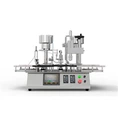
The feeding mechanism of a filling machine is a crucial aspect that determines its efficiency, accuracy, and overall performance. As a filling machine supplier, I've witnessed firsthand how different feeding mechanisms can transform the filling process for various industries. In this blog, we'll delve into the intricacies of the feeding mechanism of a filling machine, exploring its types, working principles, and applications.
Types of Feeding Mechanisms
Gravity Feeding
Gravity feeding is one of the simplest and most common feeding mechanisms used in filling machines. It relies on the force of gravity to move the product from a hopper or storage container into the filling nozzles. This mechanism is ideal for free - flowing liquids such as water, juices, and light oils.
The working principle of gravity feeding is straightforward. The product is stored in a hopper positioned above the filling nozzles. When the filling cycle starts, a valve opens, allowing the product to flow down through the nozzles and into the containers below. The flow rate can be controlled by adjusting the size of the opening in the valve or the height of the hopper.
Gravity - fed filling machines are cost - effective and easy to maintain. They are commonly used in industries where high - speed filling is not required, such as small - scale beverage production or pharmaceutical filling. For example, in a small juice bar, a gravity - fed filling machine can be used to fill individual bottles with freshly squeezed juice.
Piston Feeding
Piston feeding is a more precise and versatile feeding mechanism compared to gravity feeding. It uses a piston to draw the product from a reservoir and then push it into the containers. This mechanism is suitable for a wide range of products, including viscous liquids, creams, and pastes.
The piston in a piston - fed filling machine is typically driven by a motor or a pneumatic cylinder. When the piston retracts, it creates a vacuum that draws the product into the cylinder. Then, when the piston moves forward, it pushes the product out through the filling nozzle. The volume of the product dispensed can be accurately controlled by adjusting the stroke length of the piston.
Piston - fed filling machines are widely used in the food, cosmetic, and pharmaceutical industries. For instance, in the cosmetic industry, they are used to fill jars with creams and lotions. The precision of piston feeding ensures that each container receives the exact amount of product, which is crucial for maintaining product quality and consistency.
Pump Feeding
Pump feeding is another popular feeding mechanism, especially for applications that require high - speed filling or the handling of large volumes of product. There are several types of pumps used in filling machines, including peristaltic pumps, gear pumps, and diaphragm pumps.
Peristaltic pumps work by squeezing a flexible tube to move the product through the pump. This type of pump is gentle on the product and is suitable for filling products that are sensitive to shear forces, such as biological fluids. Gear pumps, on the other hand, use rotating gears to move the product. They are efficient and can handle high - viscosity products. Diaphragm pumps use a diaphragm to create a pumping action. They are commonly used for filling corrosive or abrasive products.
Pump - fed filling machines are commonly used in industries such as chemical manufacturing, where large volumes of liquids need to be filled quickly and accurately. For example, in a chemical plant, a pump - fed filling machine can be used to fill drums with various chemicals.


Working Principles of the Feeding Mechanism
The feeding mechanism of a filling machine is designed to ensure a smooth and consistent flow of product from the storage container to the filling nozzles. To achieve this, several key components work together.
First, there is the product storage container, which can be a hopper, a tank, or a reservoir. The container should be designed to prevent the product from settling or clogging. For example, in a filling machine for granular products, the hopper may be equipped with a vibrating mechanism to keep the granules flowing freely.
Next, there are the valves and pumps that control the flow of the product. These components are crucial for regulating the flow rate and ensuring accurate filling. For example, in a piston - fed filling machine, the valve controls the entry and exit of the product from the piston cylinder.
Finally, there are the filling nozzles, which are responsible for delivering the product into the containers. The design of the nozzles can vary depending on the type of product and the filling requirements. For example, for foamy products, the nozzles may be designed to minimize foaming.
Applications of Different Feeding Mechanisms
The choice of feeding mechanism depends on the nature of the product, the filling speed requirements, and the level of accuracy needed.
For free - flowing liquids with low viscosity, gravity feeding is often the most cost - effective option. It is commonly used in the beverage industry for filling bottles and cans with water, soda, and other non - viscous liquids. You can explore our Bottle Filling Machine for more information on filling free - flowing liquids into bottles.
For viscous products such as creams, pastes, and thick sauces, piston feeding is the preferred choice. It offers high precision and can handle a wide range of viscosities. Our 3 Axis Desktop Quantitative Filling Machine is a great example of a machine that uses piston feeding for accurate filling of viscous products.
For high - speed filling of large volumes of liquid, pump feeding is the most suitable option. It is widely used in industries such as chemical manufacturing, oil and gas, and food processing. Our Liquid Filling Machine is designed to use pump feeding for efficient and accurate filling of large - scale liquid products.
Conclusion
The feeding mechanism of a filling machine is a complex and critical part of the filling process. Understanding the different types of feeding mechanisms, their working principles, and applications is essential for choosing the right filling machine for your specific needs.
As a filling machine supplier, we are committed to providing high - quality filling machines with advanced feeding mechanisms. Whether you need to fill free - flowing liquids, viscous products, or large volumes of liquid, we have the right solution for you.
If you are interested in our filling machines or have any questions about the feeding mechanism, please feel free to contact us for a detailed discussion. We look forward to working with you to meet your filling requirements.
References
- "Filling Machine Technology" by John Smith, published by Industrial Press.
- "Principles of Packaging Machinery" by Mary Johnson, published by Packaging Institute.