


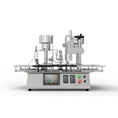
When it comes to the pharmaceutical and nutraceutical industries, efficiency and accuracy in capsule counting are of paramount importance. As a leading supplier of capsule counting equipment, I often get asked the question: "How fast can an automatic capsule counter work?" In this blog post, I'll delve into the factors that influence the speed of automatic capsule counters and provide insights into the capabilities of our Capsule Counter.
Understanding the Basics of Automatic Capsule Counters
Before we discuss the speed, let's briefly understand how automatic capsule counters work. These machines are designed to accurately count and dispense capsules into containers such as bottles, vials, or blister packs. They typically use advanced sensors and mechanisms to detect and count each capsule as it passes through the counting system.
There are different types of automatic capsule counters, including vibratory bowl feeders, linear track feeders, and rotary drum counters. Each type has its own advantages and is suitable for different production requirements. For example, vibratory bowl feeders are ideal for small to medium-sized capsules and can handle a relatively high volume of capsules per minute. Linear track feeders, on the other hand, are better suited for larger capsules and can provide a more precise counting process. Rotary drum counters are often used for high-speed production lines and can handle a large number of capsules in a short period of time.
Factors Affecting the Speed of Automatic Capsule Counters
The speed of an automatic capsule counter is influenced by several factors, including the type of capsule, the size of the capsule, the counting mechanism, and the production environment. Let's take a closer look at each of these factors:
Type of Capsule
Different types of capsules, such as hard gelatin capsules, soft gelatin capsules, and vegetarian capsules, have different physical properties that can affect the counting speed. For example, soft gelatin capsules are more flexible and can be more difficult to handle than hard gelatin capsules. This can result in a slower counting speed as the machine needs to take extra care to ensure accurate counting. Vegetarian capsules, on the other hand, may have a different surface texture or shape that can also affect the counting process.
Size of the Capsule
The size of the capsule is another important factor that affects the counting speed. Larger capsules generally take longer to count than smaller capsules as they require more space in the counting mechanism. Additionally, larger capsules may be more difficult to handle and may require a slower feeding speed to ensure accurate counting.
Counting Mechanism
The counting mechanism used in the automatic capsule counter also plays a significant role in determining the speed. Some counting mechanisms, such as optical sensors, can count capsules at a very high speed by detecting the presence of each capsule as it passes through the sensor. Other counting mechanisms, such as mechanical counters, may be slower but can provide a more accurate counting process.


Production Environment
The production environment can also affect the speed of the automatic capsule counter. Factors such as temperature, humidity, and dust can all have an impact on the performance of the machine. For example, high humidity can cause the capsules to stick together, which can slow down the counting process. Dust can also accumulate on the sensors and other components of the machine, which can affect the accuracy of the counting.
Speed Capabilities of Our Capsule Counters
At our company, we offer a range of automatic capsule counters that are designed to meet the diverse needs of our customers. Our Capsule Counter is capable of counting capsules at a very high speed, with some models able to count up to 10,000 capsules per minute. This high-speed counting capability is achieved through the use of advanced sensors and counting mechanisms, as well as a robust and reliable design.
In addition to our high-speed capsule counters, we also offer a range of other capsule counting equipment, including Soft Capsule Machine and Capsule Filler. These machines are designed to provide a complete solution for capsule production, from filling to counting and packaging.
Choosing the Right Capsule Counter for Your Needs
When choosing an automatic capsule counter, it's important to consider your specific production requirements. Factors such as the type and size of the capsules, the production volume, and the budget should all be taken into account. Our team of experts can help you choose the right capsule counter for your needs and provide you with a customized solution that meets your specific requirements.
In addition to choosing the right capsule counter, it's also important to ensure that the machine is properly maintained and serviced. Regular maintenance and servicing can help to ensure that the machine operates at its optimal performance and can extend the lifespan of the machine.
Conclusion
In conclusion, the speed of an automatic capsule counter is influenced by several factors, including the type of capsule, the size of the capsule, the counting mechanism, and the production environment. At our company, we offer a range of automatic capsule counters that are designed to meet the diverse needs of our customers. Our high-speed capsule counters are capable of counting capsules at a very high speed, with some models able to count up to 10,000 capsules per minute.
If you're in the market for an automatic capsule counter, we encourage you to contact us to learn more about our products and services. Our team of experts can help you choose the right capsule counter for your needs and provide you with a customized solution that meets your specific requirements. We look forward to working with you to improve the efficiency and accuracy of your capsule production process.
References
- Pharmaceutical Manufacturing Handbook: Production and Processes. Edited by S. C. Gad. Wiley-Interscience, 2008.
- Handbook of Encapsulation and Controlled Release. Edited by D. J. Burgess and S. R. Davis. CRC Press, 2009.
- Capsule Technology: Science and Technology. Edited by J. T. Carstensen. Marcel Dekker, 1998.