


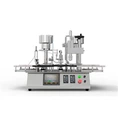
What is the sealing adaptability of an ampoule sealer to different ampoule shapes?
As a supplier of Ampoule Sealer, I've witnessed firsthand the diverse requirements that come with different ampoule shapes. Ampoules are widely used in the pharmaceutical, cosmetic, and food industries to preserve and protect their contents. The sealing process is crucial as it ensures the integrity and sterility of the product inside. In this blog, we'll explore the sealing adaptability of an ampoule sealer to various ampoule shapes.
The Importance of Sealing Adaptability
Ampoules come in a variety of shapes and sizes, including straight - necked, curved - necked, and tapered ampoules. Each shape presents unique challenges when it comes to sealing. A high - quality ampoule sealer must be able to adapt to these different shapes to provide a consistent and reliable seal.
The sealing process is not just about closing the ampoule; it's about creating a hermetic seal that prevents the ingress of air, moisture, and contaminants. A poor seal can lead to product degradation, spoilage, and potential health risks for the end - user. Therefore, the ability of an ampoule sealer to adapt to different ampoule shapes is of utmost importance.
Understanding Different Ampoule Shapes
Straight - Necked Ampoules
Straight - necked ampoules are the most common type. They are relatively easy to seal because the neck provides a consistent and straightforward area for the sealer to work on. Most standard ampoule sealers are designed to handle straight - necked ampoules efficiently. The sealer can apply heat evenly around the neck, causing the glass to melt and form a tight seal.
However, even with straight - necked ampoules, there can be variations in diameter and wall thickness. A good ampoule sealer should be able to adjust its heat output and sealing pressure to accommodate these differences. For example, if the ampoule has a thicker wall, the sealer may need to increase the heat and the pressure applied during the sealing process to ensure a proper seal.
Curved - Necked Ampoules
Curved - necked ampoules are often used for specialized products or for aesthetic reasons. Sealing curved - necked ampoules is more challenging than straight - necked ones. The curvature of the neck means that the sealer needs to be able to follow the contour of the glass accurately.
Some advanced Ampoule Sealing Machine are equipped with adjustable sealing heads that can be angled to match the curve of the ampoule neck. This allows for a more even application of heat and pressure, resulting in a better seal. Additionally, the sealer may need to use a more precise heating system to ensure that the heat is concentrated only on the neck area and does not affect the rest of the ampoule.
Tapered Ampoules
Tapered ampoules have a neck that gradually narrows towards the top. This shape is often used to facilitate pouring or to provide a more ergonomic design. Sealing tapered ampoules requires the sealer to be able to adjust to the changing diameter of the neck.
The sealer needs to be able to control the heat and pressure precisely as it moves along the tapered neck. If the heat is too high or the pressure is too strong at the narrow end, it can cause the glass to crack or shatter. On the other hand, if the heat is too low or the pressure is too weak, the seal may not be complete. Some modern ampoule sealers use sensors to detect the diameter of the neck and adjust the sealing parameters accordingly.
Factors Affecting Sealing Adaptability
Heating System
The heating system is one of the most critical components of an ampoule sealer. Different ampoule shapes require different heating profiles. For example, a straight - necked ampoule may require a uniform heating around the entire neck, while a curved - necked ampoule may need a more targeted heating along the curve.
Some ampoule sealers use gas - flame heating, which provides a high - intensity heat source. Gas - flame heating can be adjusted to some extent to adapt to different ampoule shapes. However, it requires careful control to avoid overheating or uneven heating. Other sealers use electric heating elements, which offer more precise temperature control. Electric heating elements can be programmed to provide different heating patterns, making them more suitable for sealing ampoules with complex shapes.
Sealing Head Design
The design of the sealing head also plays a crucial role in sealing adaptability. A well - designed sealing head should be able to conform to the shape of the ampoule neck. For straight - necked ampoules, a simple circular sealing head may be sufficient. However, for curved - necked or tapered ampoules, the sealing head needs to be more flexible.
Some sealing heads are made of materials that can withstand high temperatures and have a certain degree of elasticity. This allows them to adapt to the shape of the ampoule neck during the sealing process. Additionally, the sealing head should be easy to replace or adjust to accommodate different ampoule sizes and shapes.
Control System
A modern ampoule sealer is often equipped with a sophisticated control system. The control system allows the operator to set and adjust various parameters such as heating time, temperature, and sealing pressure. This is essential for adapting to different ampoule shapes.
For example, when sealing a curved - necked ampoule, the operator can adjust the heating time and temperature to ensure that the glass melts evenly along the curve. The control system can also store different sealing programs for different ampoule shapes, making it easier to switch between production runs.
Our Solutions as an Ampoule Sealer Supplier
As a leading supplier of Ampoule Machine, we understand the challenges of sealing different ampoule shapes. Our ampoule sealers are designed with advanced features to ensure high - quality sealing adaptability.


Our heating systems are highly adjustable, allowing us to provide the right amount of heat for different ampoule shapes and sizes. We offer both gas - flame and electric heating options, depending on the customer's requirements. Our sealing heads are made of high - quality materials and are designed to be flexible and easy to adjust. They can conform to the shape of the ampoule neck, ensuring a tight and consistent seal.
In addition, our control systems are user - friendly and can store multiple sealing programs. This makes it easy for our customers to switch between different ampoule shapes without having to re - program the sealer every time.
Contact Us for Sealing Solutions
If you are in the market for an ampoule sealer that can adapt to different ampoule shapes, look no further. Our team of experts is ready to help you find the best solution for your specific needs. Whether you are dealing with straight - necked, curved - necked, or tapered ampoules, we have the technology and experience to provide a reliable and efficient sealing solution.
Contact us today to start a conversation about your ampoule sealing requirements. We are committed to providing you with the highest quality products and excellent customer service.
References
- Pharmaceutical Packaging Technology Handbook, edited by David A. T. Southgate.
- Glass Packaging: Materials and Technology, by Peter M. Kelly.
- "Advances in Ampoule Sealing Technology" in the Journal of Pharmaceutical Packaging Research.