


What is the capacity of a vial filler?
As a seasoned supplier of vial filling equipment, I've witnessed firsthand the diverse needs and inquiries from our clients. One of the most frequently asked questions revolves around the capacity of a vial filler. In this blog, I'll delve into the intricacies of vial filler capacity, exploring the factors that influence it and how it impacts your production process.
Understanding Vial Filler Capacity
The capacity of a vial filler refers to the number of vials it can fill within a specific time frame, typically measured in vials per minute (VPM). This metric is crucial for pharmaceutical, biotechnology, and other industries that rely on accurate and efficient vial filling. A higher capacity vial filler can significantly increase production output, reducing labor costs and improving overall efficiency.
However, it's important to note that vial filler capacity is not a one - size - fits - all concept. Several factors come into play when determining the optimal capacity for your operation.
Factors Affecting Vial Filler Capacity
1. Vial Size and Shape
The size and shape of the vials being filled have a direct impact on the filling speed. Smaller vials generally take less time to fill compared to larger ones. Vials with irregular shapes or non - standard dimensions may also slow down the filling process, as the filler needs to adjust to accommodate these variations. For example, a vial filler that can handle small, cylindrical vials at a high speed may experience a reduced capacity when filling large, rectangular vials.
2. Filling Volume
The volume of liquid to be filled into each vial is another critical factor. Filling larger volumes naturally takes more time. A vial filler may be able to achieve a high capacity when filling small volumes, such as 1 - 5 mL, but its capacity will decrease when filling larger volumes, like 50 - 100 mL. This is because the filler needs to dispense a larger amount of liquid accurately, which requires more time for each cycle.
3. Filling Technology
Different vial filling technologies offer varying levels of capacity. Piston fillers are commonly used for their accuracy and ability to handle a wide range of viscosities. However, they may have a lower capacity compared to peristaltic fillers, which can achieve higher filling speeds, especially for low - viscosity liquids. Rotary vial fillers, on the other hand, are known for their high - speed production capabilities, making them suitable for large - scale manufacturing.
4. Automation Level
The degree of automation in a vial filler also affects its capacity. Manual or semi - automatic vial fillers typically have a lower capacity as they require more human intervention. Fully automatic vial fillers, on the other hand, can operate continuously with minimal human input, resulting in a higher filling capacity. These automated systems can include features such as automatic vial feeding, filling, and capping, which streamline the production process and increase efficiency.
Calculating Vial Filler Capacity
To calculate the capacity of a vial filler, you need to consider the cycle time of the filling process. The cycle time includes the time it takes to move a vial into position, fill it, and move it out of the filling area. Once you know the cycle time, you can calculate the number of vials that can be filled per minute using the following formula:
Capacity (VPM)=60 / Cycle Time (seconds)
For example, if the cycle time of a vial filler is 3 seconds, the capacity would be 60 / 3 = 20 vials per minute.
Real - World Examples of Vial Filler Capacity
Let's take a look at some real - world scenarios to illustrate how different factors can affect vial filler capacity.
Scenario 1: Small - Scale Production
A small pharmaceutical company is producing a specialty medication in 5 mL vials. They are using a semi - automatic piston filler. The vials are standard cylindrical shape, and the filling process is relatively straightforward. With a cycle time of 5 seconds per vial, the capacity of this vial filler would be 60 / 5 = 12 vials per minute. This is suitable for their low - volume production needs.
Scenario 2: Large - Scale Production
A large biotechnology firm is manufacturing a vaccine in 1 mL vials. They have invested in a fully automatic rotary vial filler. The vials are small and uniform in shape, and the filler is designed to handle high - speed production. With a cycle time of 1 second per vial, the capacity of this vial filler would be 60 / 1 = 60 vials per minute. This high capacity allows them to meet the large - scale demand for their product.
Choosing the Right Vial Filler Capacity for Your Business
When selecting a vial filler, it's essential to choose a capacity that aligns with your production requirements. If you are a small - scale producer with limited production volumes, a vial filler with a lower capacity may be sufficient. This can help you save on costs while still meeting your production needs.
On the other hand, if you are a large - scale manufacturer with high - volume production requirements, investing in a high - capacity vial filler is crucial. This will enable you to increase your output, reduce production time, and improve your bottom line.
It's also important to consider future growth when choosing a vial filler. Selecting a vial filler with a slightly higher capacity than your current needs can provide room for expansion as your business grows.


Related Equipment for Vial Filling
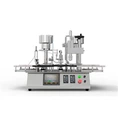
In addition to vial fillers, there are other essential pieces of equipment in the vial filling process. A Vial Sealing Machine is used to seal the vials after filling, ensuring the product's integrity. A Stoppering Machine is used to insert stoppers into the vials, providing an additional layer of protection. And of course, the Vial Filling Machine itself is the core of the operation, responsible for accurately dispensing the liquid into the vials.
Conclusion
The capacity of a vial filler is a multifaceted concept that depends on various factors such as vial size, filling volume, filling technology, and automation level. Understanding these factors and how they interact is crucial for choosing the right vial filler for your business. Whether you are a small - scale producer or a large - scale manufacturer, selecting the appropriate vial filler capacity can significantly impact your production efficiency and profitability.
If you are in the market for a vial filler or have any questions about vial filling capacity, I encourage you to reach out. Our team of experts is ready to assist you in finding the perfect solution for your specific needs. Let's start a conversation about how we can optimize your vial filling process and take your production to the next level.
References
- Pharmaceutical Filling Equipment Handbook.
- Industry reports on vial filling technology and trends.