


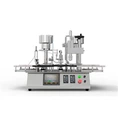
As a seasoned supplier of capping machines, I understand the significance of technical parameters in ensuring the optimal performance and efficiency of these essential pieces of equipment. In this blog post, I'll delve into the key technical parameters of a capping machine, offering insights that can help you make an informed decision when choosing the right machine for your production needs.
Capping Speed
One of the most critical technical parameters of a capping machine is its capping speed, which refers to the number of containers the machine can cap per minute. This parameter is directly related to the production capacity of your line. High - speed capping machines can handle hundreds or even thousands of containers per minute, making them suitable for large - scale production facilities. On the other hand, slower capping machines are more appropriate for small - to medium - sized operations.
When considering capping speed, it's essential to match it with your overall production line speed. If the capping machine is too slow, it can become a bottleneck in the production process, causing delays and reducing efficiency. Conversely, an overly fast capping machine may lead to increased costs without a corresponding increase in productivity if your production line cannot supply containers at the same rate.
Cap Size Compatibility
Capping machines need to be able to handle different cap sizes and types. The range of cap sizes that a machine can accommodate is an important technical parameter. Most modern capping machines are designed to be adjustable to work with a variety of cap diameters and heights. This flexibility allows manufacturers to use the same machine for different products, reducing the need for multiple capping machines.
For example, if you produce products with both small and large caps, you'll need a capping machine that can handle the full range of sizes. Some machines use interchangeable parts or adjustable mechanisms to adapt to different cap sizes, while others may require more significant modifications.
Torque Control
Torque control is another crucial parameter. Torque refers to the rotational force applied to the cap when it is being tightened onto the container. Proper torque control ensures that the caps are tightened securely enough to prevent leakage but not so tightly that they damage the container or the cap itself.
A capping machine with precise torque control can maintain consistent torque levels across all containers, which is essential for product quality and safety. Some advanced capping machines use electronic torque sensors to monitor and adjust the torque in real - time, providing a high level of accuracy.
Container Compatibility
In addition to cap size, the capping machine must be compatible with different container types and sizes. This includes factors such as container shape (round, square, oval), material (glass, plastic, metal), and height. The machine should be able to handle the containers smoothly through the capping process without causing any damage.


For instance, if you are capping glass vials, the machine needs to be gentle enough to avoid breaking the fragile glass. Some capping machines are specifically designed for certain container types, while others offer more versatility.
Power Requirements
The power requirements of a capping machine are also an important consideration. This includes the electrical power (voltage and amperage) and, in some cases, pneumatic power if the machine uses air - operated components. Understanding the power requirements is crucial for ensuring that the machine can be integrated into your existing production facility without overloading the electrical system.
For example, a large - scale, high - speed capping machine may require a significant amount of electrical power, while a smaller, manual or semi - automatic machine may have much lower power needs.
Machine Dimensions and Footprint
The physical dimensions of the capping machine, including its length, width, and height, as well as its footprint (the area it occupies on the factory floor), are important technical parameters. In a production facility, space is often limited, so you need to choose a capping machine that can fit into your available space.
Some capping machines are designed to be compact and can be easily integrated into existing production lines, while others may be larger and require more dedicated space. Additionally, consider the accessibility of the machine for maintenance and cleaning purposes.
Automation Level
Capping machines can range from manual to fully automated. The automation level is an important technical parameter that affects the efficiency, labor requirements, and overall cost of the capping process.
Manual capping machines require an operator to place the caps on the containers and initiate the capping process. They are suitable for small - scale production or for products with low production volumes. Semi - automatic capping machines may require some manual intervention, such as placing the caps, but the actual capping process is automated. Fully automated capping machines can handle the entire capping process, from cap feeding to tightening, without any human intervention. These machines are ideal for high - volume production.
Cap Feeding System
The cap feeding system is an integral part of a capping machine. It is responsible for delivering the caps to the capping head in an orderly manner. There are different types of cap feeding systems, including vibratory bowl feeders, centrifugal feeders, and linear feeders.
Vibratory bowl feeders are commonly used and work by vibrating the bowl to orient and feed the caps. Centrifugal feeders use centrifugal force to move the caps, while linear feeders transport the caps in a straight line. The choice of cap feeding system depends on factors such as the cap shape, size, and the required feeding speed.
Capping Accuracy
Capping accuracy refers to how precisely the capping machine places the cap on the container and tightens it. High - accuracy capping machines can ensure that the caps are centered correctly on the container and tightened evenly. This is important for both the appearance of the product and its functionality.
A capping machine with poor accuracy may result in misaligned caps, which can affect the product's seal and overall quality. Advanced capping machines use sensors and precision mechanisms to achieve high levels of capping accuracy.
Maintenance Requirements
The maintenance requirements of a capping machine are also a significant technical consideration. Machines with simple designs and easy - to - access components are generally easier to maintain. Regular maintenance is essential to keep the machine running smoothly and to prevent breakdowns.
Some capping machines require frequent lubrication, cleaning, and replacement of parts, while others are designed to be low - maintenance. Understanding the maintenance requirements in advance can help you plan for the long - term operation of the machine.
Integration with Other Equipment
In a production line, the capping machine needs to be integrated with other equipment such as Vial Filler and Vial Sealing Machine. Compatibility and seamless integration are important technical parameters.
The capping machine should be able to communicate and synchronize with other equipment to ensure a continuous and efficient production process. For example, it should be able to receive containers from the filler at the right time and pass them on to the sealing machine without any disruptions.
Conclusion
As a Capping Machine supplier, I know that understanding these technical parameters is essential for choosing the right capping machine for your business. Each parameter plays a vital role in the machine's performance, efficiency, and overall suitability for your production needs.
If you're in the market for a capping machine, I encourage you to contact us to discuss your specific requirements. Our team of experts can help you select the most appropriate capping machine based on the technical parameters that matter most to you. Whether you need a high - speed machine for large - scale production or a flexible machine for handling multiple cap and container sizes, we have the solutions to meet your needs. Let's start a conversation about how our capping machines can enhance your production process.
References
- Packaging Machinery Manufacturers Institute (PMMI). Packaging Machinery Technology and Trends.
- Industry publications on capping and packaging technology.