


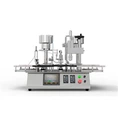
Hey there! I'm a supplier of Ampoule Fillers, and today I wanna talk about one of the most common questions I get asked: What is the production capacity per hour of an ampoule filler? It's a crucial question for anyone in the pharmaceutical, cosmetic, or any industry that uses ampoules for product packaging.
First off, let's understand what an ampoule filler does. It's a machine designed to accurately fill ampoules with various liquids, such as medications, essential oils, or other liquid products. The production capacity per hour can vary widely depending on several factors.
Factors Affecting Production Capacity
1. Machine Model and Design
Different models of ampoule fillers come with different capabilities. Some are designed for small - scale production, like those used in research labs or for specialty products. These might have a production capacity of around 300 - 1000 ampoules per hour. They're usually more compact and can be easily adjusted for different fill volumes.


On the other hand, industrial - grade ampoule fillers are built for high - volume production. These can churn out anywhere from 2000 to 10,000 ampoules per hour. They're equipped with advanced technology and multiple filling heads to speed up the process. For example, a multi - head ampoule filler can fill several ampoules simultaneously, greatly increasing the output.
2. Fill Volume
The amount of liquid being filled into each ampoule also plays a big role. Smaller fill volumes generally allow for a higher production rate. If you're filling 1 ml ampoules, the machine can work faster compared to filling 10 ml ampoules. This is because less time is needed to dispense the smaller volume of liquid.
3. Product Viscosity
The thickness or viscosity of the liquid being filled matters too. Thin, watery liquids flow easily and can be filled more quickly. For instance, filling a saline solution will be much faster than filling a thick oil - based product. High - viscosity liquids may require more time for the filling mechanism to push the product into the ampoules, reducing the overall production capacity.
4. Operator Skill and Experience
A well - trained operator can make a significant difference in the production capacity. An experienced operator knows how to set up the machine correctly, troubleshoot minor issues quickly, and keep the production line running smoothly. They can optimize the machine's settings for maximum efficiency, which can increase the number of ampoules filled per hour.
Examples of Production Capacities
Let's take a look at some real - world examples. Suppose you have a basic single - head ampoule filler. This type of machine is often used for small - batch production. If you're filling 2 ml ampoules with a low - viscosity liquid like water, it might be able to produce around 500 - 600 ampoules per hour.
Now, consider a high - end, multi - head industrial ampoule filler. With six filling heads and set up to fill 5 ml ampoules of a medium - viscosity liquid, it could potentially produce 4000 - 5000 ampoules per hour.
How to Choose the Right Ampoule Filler Based on Production Capacity
When you're in the market for an ampoule filler, you need to have a clear idea of your production requirements. If you're a startup or a small - scale producer, a low - capacity machine might be the way to go. It's more cost - effective and easier to operate. You can always upgrade as your business grows.
For large - scale manufacturers, investing in a high - capacity ampoule filler is essential. It may have a higher upfront cost, but the increased production output will lead to greater efficiency and profitability in the long run.
If you're not sure which machine is right for you, you can always reach out to us. We've got a wide range of Ampoule Fillers to suit different needs and budgets.
The Role of Ampoule Sealing Machines and Ampoule Machines
Once the ampoules are filled, they need to be sealed properly. That's where Ampoule Sealing Machines come in. These machines ensure that the filled ampoules are securely sealed to prevent leakage and contamination. The sealing process also needs to be efficient to keep up with the filling production rate.
An Ampoule Machine is a more comprehensive solution that combines the filling and sealing functions. It offers a seamless production process, reducing the need for multiple machines and manual handling. This can further increase the overall production capacity and improve the quality of the final product.
Conclusion
So, as you can see, the production capacity per hour of an ampoule filler can vary greatly depending on various factors. It's important to consider your specific production needs, the type of product you're filling, and your budget when choosing an ampoule filler.
If you're interested in learning more about our ampoule fillers or have any questions about production capacity, feel free to get in touch with us. We're here to help you find the perfect solution for your business. Whether you're just starting out or looking to upgrade your existing production line, we've got the expertise and the products to meet your requirements. Let's start a conversation and see how we can boost your production efficiency together.
References
- Pharmaceutical Packaging Technology Handbook, various authors
- Industrial Filling and Sealing Equipment Manuals