


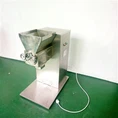
As a seasoned supplier of China granulators, I've witnessed firsthand the diverse requirements and applications that our machinery serves. One of the most frequently asked questions from our clients is about the output particle size of our granulators. In this blog, I'll delve into the factors influencing the output particle size, the typical ranges, and how our granulators can be tailored to meet specific needs.
Factors Influencing Output Particle Size
The output particle size of a granulator is determined by a combination of several factors, each playing a crucial role in the final product. Understanding these factors is essential for achieving the desired particle size and ensuring the quality of the granules.
Screen Size
The screen is one of the most critical components of a granulator, as it directly determines the maximum size of the particles that can pass through. Different screen sizes are available, ranging from fine meshes for producing small particles to larger openings for coarser granules. By selecting the appropriate screen size, you can control the output particle size with precision.
Feed Material Characteristics
The properties of the feed material, such as its moisture content, density, and particle shape, can significantly affect the output particle size. Materials with high moisture content tend to form larger particles, while dry materials may result in smaller granules. Additionally, the density and particle shape of the feed material can influence the granulation process and the final particle size distribution.


Granulation Method
There are several granulation methods available, including wet granulation, dry granulation, and extrusion granulation. Each method has its own advantages and disadvantages, and the choice of method can impact the output particle size. For example, wet granulation typically produces larger and more uniform particles, while dry granulation may result in smaller and more irregularly shaped granules.
Operating Parameters
The operating parameters of the granulator, such as the rotational speed, feed rate, and pressure, can also affect the output particle size. By adjusting these parameters, you can optimize the granulation process and achieve the desired particle size. For example, increasing the rotational speed of the granulator can result in smaller particles, while increasing the feed rate may lead to larger granules.
Typical Output Particle Size Ranges
The output particle size of our China granulators can vary depending on the specific model and application. However, in general, our granulators can produce particles ranging from a few micrometers to several millimeters in diameter. Here are some typical output particle size ranges for different types of granulators:
Pharmaceutical Granulators
In the pharmaceutical industry, granulators are commonly used to produce tablets and capsules. The output particle size of pharmaceutical granulators typically ranges from 100 to 500 micrometers, depending on the specific requirements of the formulation. Smaller particles are often preferred for better dissolution and bioavailability, while larger particles may be used for improved flowability and compressibility.
Food Granulators
Food granulators are used to produce a variety of food products, such as instant drinks, spices, and snacks. The output particle size of food granulators can vary widely, depending on the type of food product and the desired texture. For example, fine particles may be used for powdered drinks, while larger particles may be preferred for snack foods.
Chemical Granulators
Chemical granulators are used to produce a wide range of chemical products, including fertilizers, pesticides, and plastics. The output particle size of chemical granulators can vary depending on the specific application and the properties of the chemical material. In general, chemical granulators can produce particles ranging from a few micrometers to several millimeters in diameter.
Tailoring Granulators to Specific Needs
At our company, we understand that every client has unique requirements when it comes to the output particle size of their granulators. That's why we offer a range of customizable granulators that can be tailored to meet specific needs. Here are some ways we can customize our granulators to achieve the desired output particle size:
Screen Selection
We offer a wide range of screen sizes and mesh configurations to suit different applications and particle size requirements. Our experienced technicians can help you select the appropriate screen size based on your specific needs and the properties of your feed material.
Granulation Method Optimization
Depending on the type of feed material and the desired output particle size, we can optimize the granulation method to achieve the best results. For example, we can adjust the wetting agent, binder, and drying conditions in wet granulation to produce particles of the desired size and shape.
Operating Parameter Adjustment
Our granulators are equipped with advanced control systems that allow us to adjust the operating parameters, such as the rotational speed, feed rate, and pressure, with precision. By optimizing these parameters, we can ensure that the granulator produces particles of the desired size and quality.
Customized Design
In some cases, our clients may require a completely customized granulator design to meet their specific needs. Our engineering team has extensive experience in designing and manufacturing custom granulators, and we can work closely with you to develop a solution that meets your exact requirements.
Importance of Particle Size in Different Industries
The output particle size of granulators plays a crucial role in various industries, as it can significantly impact the performance, quality, and functionality of the final product. Here are some examples of how particle size is important in different industries:
Pharmaceutical Industry
In the pharmaceutical industry, the particle size of the active pharmaceutical ingredient (API) and excipients can affect the dissolution rate, bioavailability, and stability of the drug product. Smaller particles generally have a higher surface area, which can improve the dissolution rate and bioavailability of the drug. Additionally, the particle size can also affect the flowability and compressibility of the granules, which are important factors in the tablet manufacturing process.
Food Industry
In the food industry, the particle size of food ingredients can affect the texture, flavor, and appearance of the final product. For example, fine particles can improve the solubility and dispersibility of powdered drinks, while larger particles can provide a crunchy texture in snack foods. Additionally, the particle size can also affect the stability and shelf life of food products, as smaller particles are more prone to agglomeration and degradation.
Chemical Industry
In the chemical industry, the particle size of chemical products can affect their reactivity, solubility, and flowability. For example, smaller particles generally have a higher surface area, which can increase the reactivity of the chemical. Additionally, the particle size can also affect the packing density and bulk density of the chemical, which are important factors in the storage and transportation of the product.
Conclusion
In conclusion, the output particle size of China granulators is a critical factor that can significantly impact the performance, quality, and functionality of the final product. By understanding the factors influencing the output particle size, the typical ranges, and how our granulators can be tailored to meet specific needs, you can make an informed decision when choosing a granulator for your application.
If you're interested in learning more about our China granulators or have any questions about the output particle size, please don't hesitate to [contact us](insert contact link). Our experienced team of technicians and sales representatives will be happy to assist you and provide you with the information you need to make the right choice for your business.
References
- Perry, R. H., & Green, D. W. (Eds.). (2008). Perry's Chemical Engineers' Handbook. McGraw-Hill.
- Lerk, C. F., & Bolhuis, G. K. (Eds.). (2001). Pharmaceutical Dosage Forms: Tablets. Marcel Dekker.
- Rhodes, M. J. (2008). Introduction to Particle Technology. Wiley.