


Can industrial mixers mix different types of powders?
In the realm of industrial manufacturing, the ability to blend different types of powders effectively is crucial across numerous sectors, including pharmaceuticals, food processing, chemicals, and cosmetics. As a leading supplier of Industrial Mixers, we are often asked whether our industrial mixers can handle the task of mixing diverse powders. The answer is a resounding yes, and in this blog, we will explore the science behind it, the challenges involved, and the solutions our mixers offer.
The Science of Powder Mixing
Powder mixing is a complex process that involves the randomization of particles to achieve a homogeneous mixture. When two or more types of powders are combined, the goal is to ensure that each particle of one powder is evenly distributed among the particles of the other powders. This is achieved through various mechanisms, including convection, diffusion, and shear.


Convection involves the movement of large groups of particles within the mixer. This can be achieved through the use of agitators, paddles, or rotating drums that move the powder around the mixing chamber. Diffusion, on the other hand, occurs when individual particles move randomly through the mixture, gradually spreading out and becoming more evenly distributed. Shear forces are used to break up agglomerates and ensure that the particles are separated and mixed more effectively.
Our industrial mixers are designed to utilize these mechanisms to achieve optimal mixing results. They are equipped with advanced agitation systems that can create a high degree of convection, ensuring that the powders are thoroughly mixed. The design of the mixing chamber and the agitators also promotes diffusion, allowing the particles to move freely and become evenly distributed. Additionally, our mixers can apply shear forces when necessary to break up any clumps or agglomerates, ensuring a uniform mixture.
Types of Powders and Their Mixing Challenges
Different types of powders present unique challenges when it comes to mixing. Powders can vary in terms of their particle size, shape, density, surface charge, and flow properties. These differences can affect how the powders behave during the mixing process and can make it more difficult to achieve a homogeneous mixture.
For example, powders with a large difference in particle size can be challenging to mix. The smaller particles tend to settle to the bottom of the mixing chamber, while the larger particles remain on top. This can result in a non-uniform mixture. Our industrial mixers are designed to address this issue by creating a turbulent flow within the mixing chamber. The agitators are designed to lift the smaller particles and distribute them evenly throughout the mixture, ensuring that the final product is homogeneous.
Powders with different densities can also be difficult to mix. The heavier powders tend to sink to the bottom, while the lighter powders float to the top. To overcome this challenge, our mixers use a combination of convection and shear forces to keep the powders in motion and ensure that they are evenly distributed. The agitators are designed to create a strong upward flow, which helps to lift the heavier powders and mix them with the lighter ones.
Surface charge can also affect the mixing process. Powders with a high surface charge tend to stick together, forming agglomerates that are difficult to break up. Our mixers are equipped with shear blades that can apply high shear forces to break up these agglomerates and ensure that the particles are evenly distributed. Additionally, we can provide anti-static coatings on the mixing chamber and agitators to reduce the build-up of static charge and prevent the powders from sticking together.
Applications of Industrial Mixers in Powder Mixing
Industrial mixers have a wide range of applications in powder mixing across various industries. In the pharmaceutical industry, for example, industrial mixers are used to blend active pharmaceutical ingredients (APIs) with excipients to create tablets, capsules, and other dosage forms. The ability to achieve a homogeneous mixture is crucial in ensuring the efficacy and safety of the final product. Our industrial mixers are designed to meet the strict quality and regulatory requirements of the pharmaceutical industry, ensuring that the powders are mixed accurately and consistently.
In the food processing industry, industrial mixers are used to blend ingredients such as flour, sugar, spices, and flavorings. The ability to mix these powders evenly is important in ensuring the quality and consistency of the final product. Our mixers are made from food-grade materials and are designed to meet the hygiene standards of the food industry. They are easy to clean and sanitize, ensuring that the powders are not contaminated during the mixing process.
In the chemical industry, industrial mixers are used to blend different types of chemicals, including pigments, dyes, and polymers. The ability to achieve a homogeneous mixture is crucial in ensuring the quality and performance of the final product. Our industrial mixers are designed to handle a wide range of chemicals and can be customized to meet the specific requirements of the chemical industry.
Our Industrial Mixers: A Solution for Powder Mixing
As a supplier of Industrial Mixers, we offer a range of high-quality mixers that are designed to meet the diverse needs of our customers. Our mixers are available in different sizes and configurations, allowing us to provide a solution for every application.
One of our popular mixer models is the ribbon blender. This type of mixer consists of a U-shaped trough with a double helical ribbon agitator. The ribbon agitator rotates within the trough, creating a strong convective flow that moves the powders from the bottom to the top and from the sides to the center. The ribbon blender is ideal for mixing powders with a wide range of particle sizes and densities.
Another popular mixer model is the planetary mixer. This type of mixer consists of a mixing bowl with one or more agitators that rotate around their own axis while also orbiting around the center of the bowl. The planetary mixer is ideal for mixing powders that require a high degree of shear, such as pastes and gels.
We also offer customized mixer solutions to meet the specific requirements of our customers. Our engineering team has extensive experience in designing and manufacturing industrial mixers, and we can work with you to develop a mixer that is tailored to your specific needs.
Complementary Equipment: Granulators
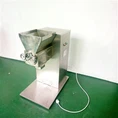
In addition to industrial mixers, we also supply Granulators and Granulator Machine. Granulators are used to convert powders into granules, which can improve the flow properties, compressibility, and dissolution rate of the powders. Our granulators are designed to work in conjunction with our industrial mixers, providing a complete solution for powder processing.
Contact Us for Your Powder Mixing Needs
If you are looking for a reliable and efficient solution for mixing different types of powders, look no further than our industrial mixers. Our mixers are designed to provide optimal mixing results, even with the most challenging powders. Whether you are in the pharmaceutical, food processing, chemical, or cosmetics industry, we have a mixer that is right for you.
Contact us today to discuss your powder mixing requirements and to learn more about our industrial mixers, granulators, and other powder processing equipment. We look forward to working with you to find the best solution for your business.
References
- Perry, R. H., & Green, D. W. (Eds.). (2007). Perry's Chemical Engineers' Handbook. McGraw-Hill.
- Harnby, N., Edwards, M. F., & Nienow, A. W. (1992). Mixing in the Process Industries. Butterworth-Heinemann.
- Fan, L. T., & Zhu, C. (1998). Principles of Gas-Solid Flows. Cambridge University Press.